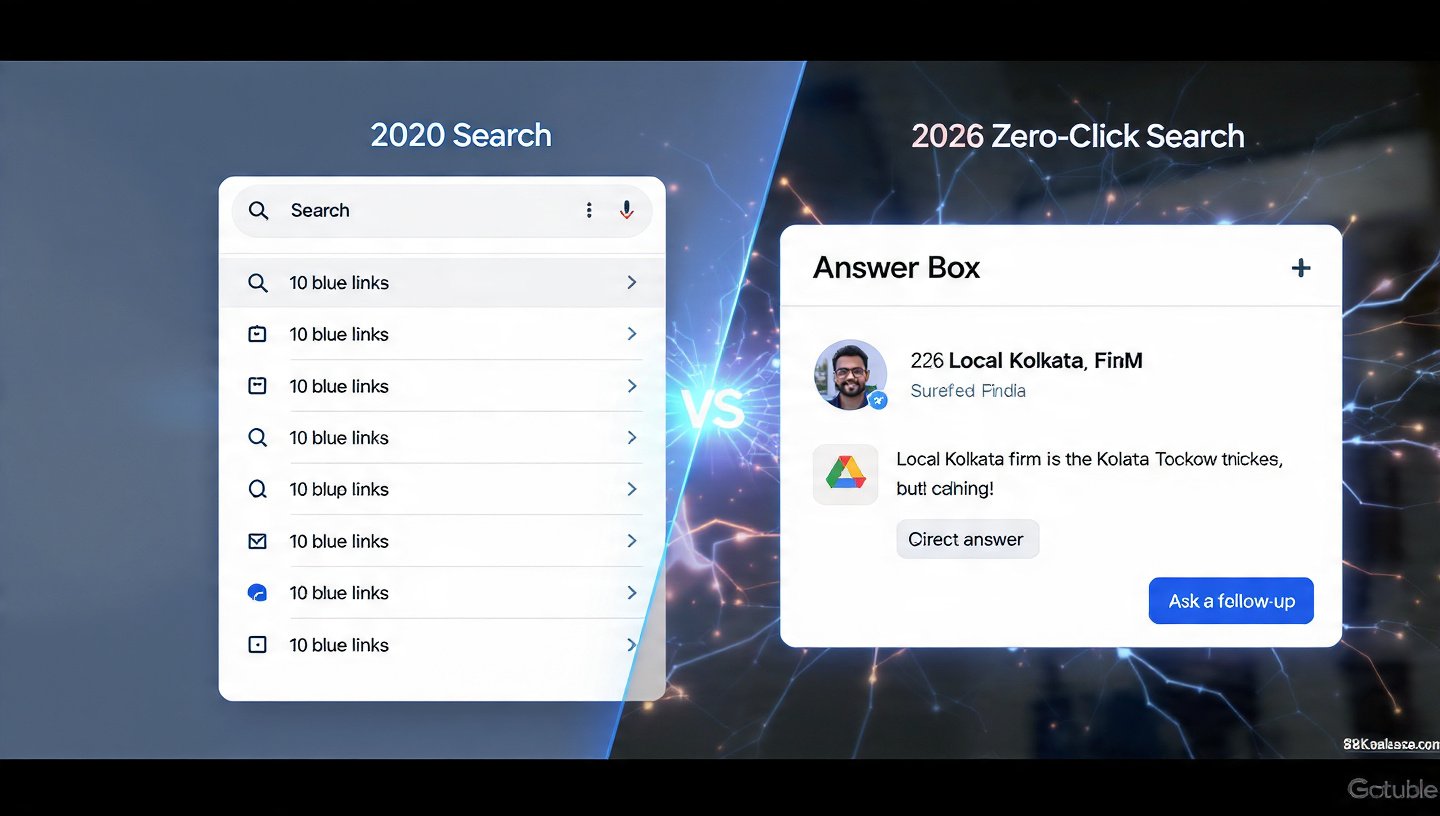
1. The 2026 Paradox: High Visibility, Low Clicks
For years, SEO was a simple math game: Rank high → Get clicks → Make sales. In 2026, Google’s goal is to keep users on Google. If a parent in Salt Lake searches for “School admission dates in South Kolkata 2026,” Google will pull that data directly from a website and show it in a box. The user gets the answer, and your website gets… zero traffic.
So why bother? Because the brand that provides the answer wins the Trust Monopoly. Even if they don’t click today, your brand becomes the “Authorized Expert” in their mind for tomorrow.
2. Winning “Position Zero”: The Content Blueprint
Google doesn’t pick the “best” website for the answer box; it picks the most extractable one. To win in 2026, your content must be written to be “lifted” by an AI.
- The 40-Word Rule: For every major question your customers ask (e.g., “How much does a modular kitchen cost in Kolkata?”), provide a direct, jargon-free answer in roughly 40–60 words immediately under the heading.
- The “H-Tag” Hierarchy: Use
<h2>for the question and<p>for the answer. This acts as a map for Google’s crawler. - Tables are King: Google loves data it can put into a comparison chart. If you list your services as a table rather than a paragraph, your chances of hitting the answer box increase by 300%.
3. The Shift to “Answer Ownership”
In 2026, we’ve moved from keyword density to Topic Authority. Instead of trying to rank for “Interior Designer,” aim to own the answers to:
- “How to design a small flat in New Town?”
- “Best waterproof materials for Kolkata monsoons?”
- “Cost of false ceilings per square foot in Ballygunge.”
When your brand appears in the AI Overview for all three, the customer perceives you as the biggest player in the city, even if they haven’t visited your site yet.
4. Technical Fuel: Schema & Structured Data
You cannot win a zero-click battle with just good writing. You need the underlying “tags” that tell Google exactly what your data means.
- FAQ Schema: Tells Google, “This is a question, and this is the specific answer.”
- How-To Schema: Breaks down processes (like “How to book a puja pandal tour”) into steps that Google can show as a list.
- LocalBusiness Schema: Ensures that when someone asks, “Is there a CA near me?” your office in Alipore pops up with your phone number and “Open Now” status.
5. Zero-Click Success Metrics: The New KPI
Since you can’t rely solely on “Clicks” anymore, how do you measure success in 2026? | Old Metric | 2026 Zero-Click Metric | Why it Matters | | :— | :— | :— | | CTR (Click Through Rate) | SERP Impressions | How many times your brand was the “source” for an answer. | | Organic Traffic | Branded Search Volume | People searching for your specific name after seeing your snippets. | | Bounce Rate | Dwell Time (on SERP) | How long users engaged with your snippet vs. others. |
6. Adapting for Voice & AI Agents
In 2026, many of these “zero-click” answers are being read aloud by Alexa or navigated by AI agents like Gemini Live.
- Conversational Tone: Write like a helpful peer, not a corporate brochure.
- Native Language: For the Kolkata market, having a “Bengali FAQ” section using schema can help you capture voice searches in the local dialect—a huge untapped “blue ocean” for 2026.
7. FAQ: The Zero-Click Dilemma
- Q: If I give the answer away for free, why would they ever buy from me?
- A: Because “Information” is free, but “Execution” is not. You give the price of the kitchen for free to prove you are honest; they hire you because they trust that honesty.
- Q: Is SEO dying because of zero-click?
- A: No, it’s evolving. It’s moving from “Traffic Generation” to “Brand Authority.” The brands that refuse to adapt will see their traffic vanish; the ones that embrace it will become household names in Kolkata.
- Q: Can I block Google from showing my content in snippets?
- A: You can, but it’s digital suicide. If you don’t provide the answer, your competitor in Sector V will, and they will get the brand credit.
Conclusion: Be the Answer, Not Just the Result
The goal of a 2026 website is to be so helpful that Google wants to feature you. By optimizing for zero-click searches, you aren’t just getting traffic; you are building a reputation that survives even if Google’s interface changes tomorrow.
At our Alipore studio, we specialize in “AEO” (Answer Engine Optimization). We’ll help you audit your content to ensure you aren’t just a link in the background, but the voice at the top.
Want to see if your brand owns its answers? Apply for a “Position Zero Audit.” We’ll identify 5 key questions your customers are asking and show you exactly how to structure your site to take the top spot from your competitors.