



1. The “Revenue Intent” Decision Matrix
In 2026, we don’t choose a website based on “pages.” We choose based on the Transaction Type.
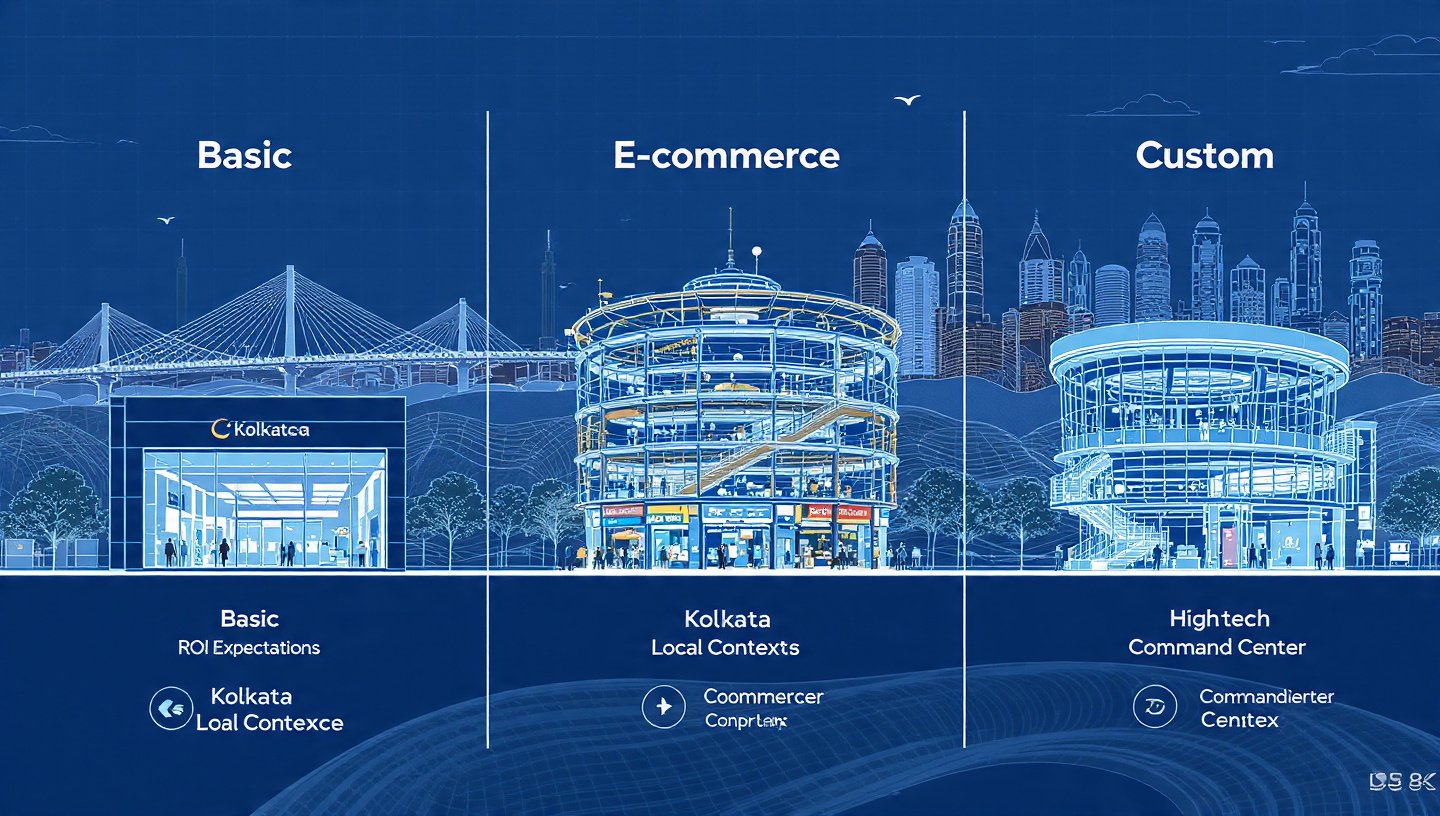
| If your primary goal is… | Your Tier is… | Why? |
| Visibility & Trust | Basic (Entity Anchor) | You sell services offline (Lawyers, Doctors, Architects) and need to be verified by Google’s AI. |
| Selling Physical Goods | E-commerce | You need inventory sync, automated shipping, and UPI payments to run 24/7. |
| Solving Work Bottlenecks | Custom (Web App) | You have complex rules, multiple stakeholders, or proprietary data that SaaS can’t handle. |
2. Tier 1: The “Digital Calling Card” (Basic)
- Best For: Local service providers in Gariahat, Alipore, or Salt Lake.
- The 2026 Requirement: It must be Light-Speed. If a customer is looking for a “Plumber in Jadavpur” on a spotty mobile connection, your site must load in under 1.2 seconds.
- Estimated Investment: ₹25,000 – ₹75,000.
- Kolkata Context: This is your primary defense against competitors. If you don’t have an “Entity Anchor,” Google will send your leads to the guy who does.
3. Tier 2: The “Retail Revolution” (E-commerce)
- Best For: D2C Brands, Boutique owners, and Manufacturers entering the digital market.
- The 2026 Requirement: Omnichannel Sync. If you sell a Saree in your physical store in Burrabazar, it must instantly disappear from your website stock.
- Estimated Investment: ₹75,000 – ₹3,50,000+ (depending on SKUs and AI features).
- Kolkata Context: With the rise of “Quick Commerce,” your site must offer hyper-local delivery estimates to compete with big platforms.
4. Tier 3: The “Unfair Advantage” (Custom Web App)
- Best For: Tech Startups in Sector V, Logistics firms, and high-volume Agencies.
- The 2026 Requirement: Proprietary IP. You aren’t just using a tool; you are building a tool that makes your company more valuable during an acquisition or funding round.
- Estimated Investment: ₹5,00,000 – ₹25,00,000+.
- Kolkata Context: Use this to automate the chaotic “Middleman” workflows typical in local manufacturing and supply chains.
5. The “Hidden” Costs of 2026: TCO (Total Cost of Ownership)
A website isn’t a one-time purchase; it’s an employee.
- Maintenance: Expect to spend 10-15% of the build cost annually on security updates, server optimization, and AI recalibration.
- Growth: In 2026, a “Static” site is a dead site. You need a budget for Continuous Conversion Testing.
6. FAQ: Finalizing Your Choice
- Q: Can I start with a Basic site and upgrade to E-commerce later?
- A: Yes, but only if you build on a Modular Stack (like WordPress/Headless). If you build on a closed DIY builder, you’ll likely have to pay for a full migration later.
- Q: Is “Custom” always better for SEO?
- A: Not necessarily. A well-optimized Shopify or WordPress site can outrank a poorly coded custom app. Custom is for Functionality, not just for “Ranking.”
- Q: How do I know if a Kolkata agency is giving me the right tier?
- A: Ask them for a “Scalability Roadmap.” If they can’t explain how your site will handle 10x more traffic next year, they are selling you a temporary fix, not a revenue engine.
Series Conclusion: The Revenue Engine Final Word
The internet of 2026 doesn’t reward “presence”—it rewards Performance, Authority, and Utility. * If you need to be found, build an Entity Anchor. * If you need to sell, build a Conversion Machine. * If you need to scale, build a Proprietary System.
At our studio, we don’t just “make websites.” We engineer the digital infrastructure that fuels your specific business goals.
Ready to pick your lane?
Let’s have a “Revenue Blueprint Session.” We’ll look at your 2026 sales targets and tell you exactly which tier will get you there with the highest ROI and the lowest technical debt.