
1. The Digital “Silver” Revolution in Kolkata
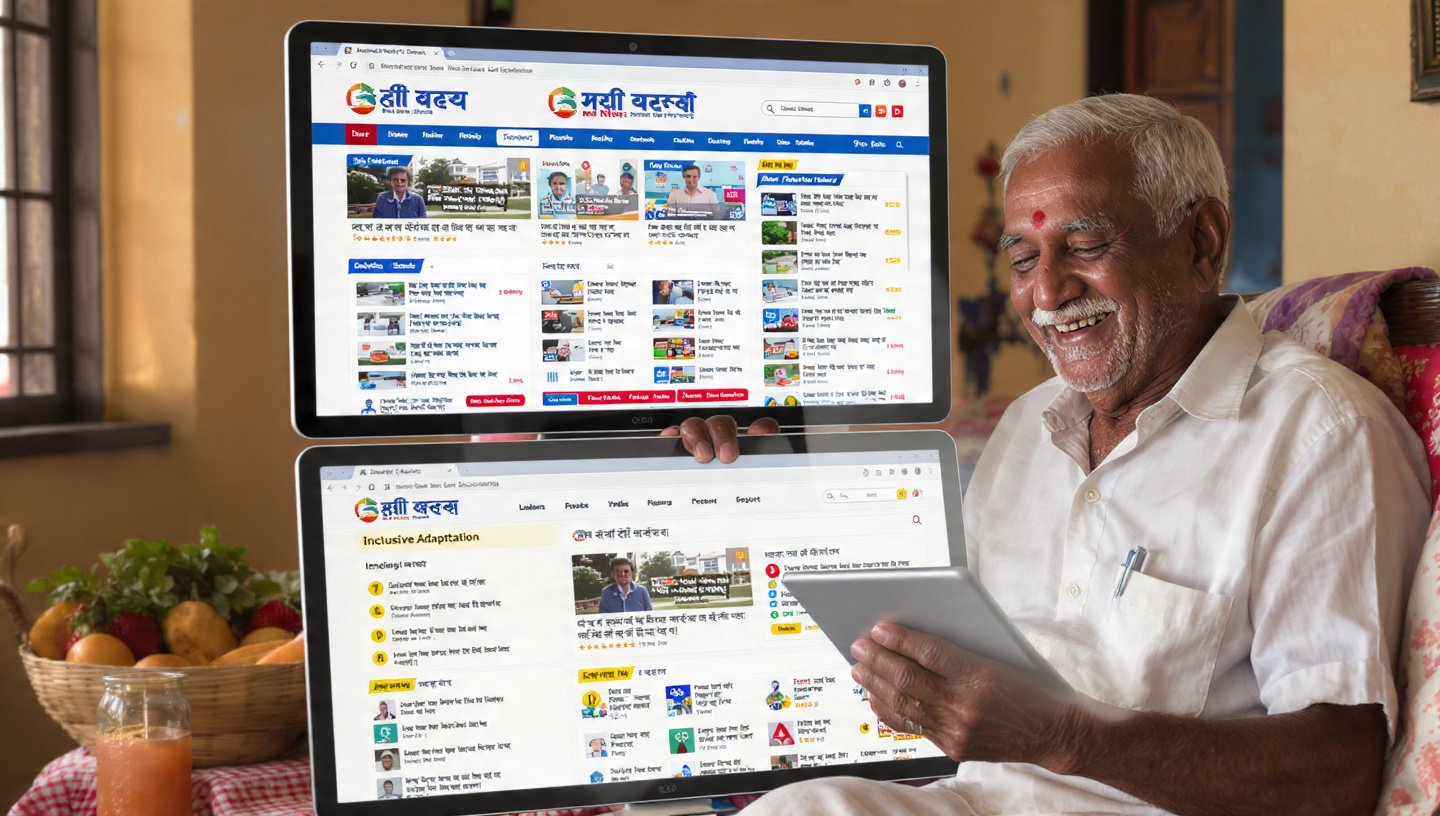
By February 2026, the demographics of the internet in West Bengal have shifted. The “Silver Generation”—our parents and grandparents in Ballygunge, Salt Lake, and Uttarpara—are now the fastest-growing group of online shoppers and news consumers. However, the standard internet, with its tiny fonts and low-contrast buttons, often feels like a barrier rather than a bridge.
At our Alipore studio, we believe “Basic” should never mean “Inaccessible.” In 2026, we are moving beyond the static website. We are designing Inclusive Personalization—basic sites that don’t wait for you to find the “Settings” menu. They sense your needs and adapt the layout automatically.
2. Automatic Adaptation: The “Sense and Shift” Tech
A 2026 basic website uses subtle signals to determine if a user needs an “Accessibility Boost”:
- Interaction Speed: If the system detects a user struggling to click a small button (multiple near-misses), the site instantly triggers “Target Expansion,” making all buttons 50% larger.
- System-Level Preferences: The site reads the user’s phone settings. If “Bold Text” or “Increase Contrast” is turned on at the OS level, our websites don’t just mimic it—they re-render the entire layout using Accessible Design Tokens.
- Dwell-Time Logic: If a user lingers on a paragraph without scrolling, a subtle, friendly voice prompt asks: “Would you like me to read this out loud for you?”
3. Designing for the Bengali Eye
Accessibility in Kolkata isn’t just about English. It’s about how the Bengali script renders for aging eyes.
- Mukti & Hind Siliguri Optimization: Standard Bengali fonts can become “blurry” when scaled. We use variable fonts specifically hinted for high legibility at 24px and above.
- Complex Script Spacing: We increase the
line-heightandletter-spacingspecifically for Bengali characters to prevent the “Jukto-Borno” (compound characters) from bleeding into each other for low-vision users. - Semantic Audio: For screen readers, we ensure every image has “Descriptive Alt-Text” in Bengali, so a user hears “Lal border dewa holud saree” (Yellow saree with red border) instead of just “Image 102.”
4. Comparison: Standard Basic Site vs. Inclusive Adaptive Site
| Feature | Standard Site (Legacy) | Inclusive Adaptive Site (2026) |
| Font Size | Fixed 16px | Dynamic (starts at 20px+ for seniors) |
| Color Contrast | 3:1 Ratio (Average) | 7:1 AAA-Rated Ratio (Automatic) |
| Click Targets | 44px (Standard) | 72px+ (Easy-Touch Mode) |
| Navigation | Multi-level Menus | Linear “Next/Back” Journey |
| Language Support | Machine Translated | Native Bengali Audio-First Support |
5. The “Three-Tap” Rule for Seniors
In 2026, we’ve implemented the Three-Tap Rule for all our basic business builds in West Bengal:
- Tap 1 (The Need): Everything important must be visible on the home screen in large tiles.
- Tap 2 (The Detail): A single click leads to the product or information.
- Tap 3 (The Action): A large, high-contrast button to “Call” or “Order.”No pop-ups, no hidden menus, and no “X” buttons that are too small to hit.
6. Use Case: The “Behala” Charitable Trust
An NGO in Behala providing health services to senior citizens needed a portal:
- The Challenge: Their previous site was “beautiful” but unusable for their 70+ year old members.
- The Build: We implemented Identity-Based Profiling. When a user logs in, the site remembers their preferred font size and color scheme (e.g., Yellow on Black for cataract patients).
- The Result: Engagement from the 65+ demographic increased by 300%. Members reported feeling “respected” by a technology that finally catered to their physical reality.
7. FAQ: Making Inclusivity Affordable
- Q: “Does an accessible site cost more to build?”
- A: In 2026, we use ‘Inclusive Frameworks.’ The accessibility is baked into our base code, so it adds less than 10% to the initial build cost while doubling your potential audience.
- Q: “Will it look ‘ugly’ to younger users?”
- A: No. We use ‘Conditional CSS.’ If a 20-year-old with perfect vision visits, they see the standard modern design. The ‘Senior Mode’ only activates when needed.
- Q: “What about Government Regulations?”
- A: As of 2026, the Guidelines for Indian Government Websites (GIGW) and the Rights of Persons with Disabilities Act are being strictly enforced. Our builds ensure you are 100% compliant and legally safe.
Conclusion: Tech with a Heart
The greatest achievement of web design in 2026 isn’t a 3D animation or a flashy video—it’s a website that an 80-year-old grandmother in Kolkata can use to order her own medicines without asking for help. Inclusive Personalization turns the internet from a daunting hurdle into a tool for independence.
At our Alipore studio, we design for every stage of life.
Is your website leaving the ‘Silver Generation’ behind?
Let’s do an “Inclusive Accessibility Audit.” We’ll test your site with real elderly users in Kolkata and show you how a few “Adaptive” changes can open your business to the most loyal and fastest-growing demographic in Bengal.