







1. The Invisible Carbon Footprint of North-South City Mall Shoppers
By February 2026, the digital world is facing a climate reckoning. Most people don’t realize that the internet is responsible for nearly 3.7% of global greenhouse gas emissions—more than the entire aviation industry. For the environmentally conscious Gen Z in Salt Lake and Ballygunge, a slow-loading, data-heavy website isn’t just a nuisance; it’s an ecological offense.
At our Alipore studio, we are seeing a massive shift. Top brands in Kolkata are no longer asking for “more flash.” They are asking for “Eco-Mode”—websites designed to deliver maximum impact with minimum energy.
2. What is a Low-Carbon Website?
A low-carbon website is engineered to reduce the energy required to load its pages. In 2026, this is achieved through four primary pillars:
- Asset Optimization: We replace heavy JPEG/PNG images with next-gen formats like WebP or AVIF, and prioritize lightweight SVG illustrations that scale without data bloat.
- Clean Code Architecture: We eliminate “code vomit”—unnecessary JavaScript libraries and bloated CSS that force a user’s device to work harder (and use more battery).
- Green Hosting: We migrate our Kolkata clients to data centers powered by 100% renewable energy, ensuring that every visit to the site is carbon-neutral.
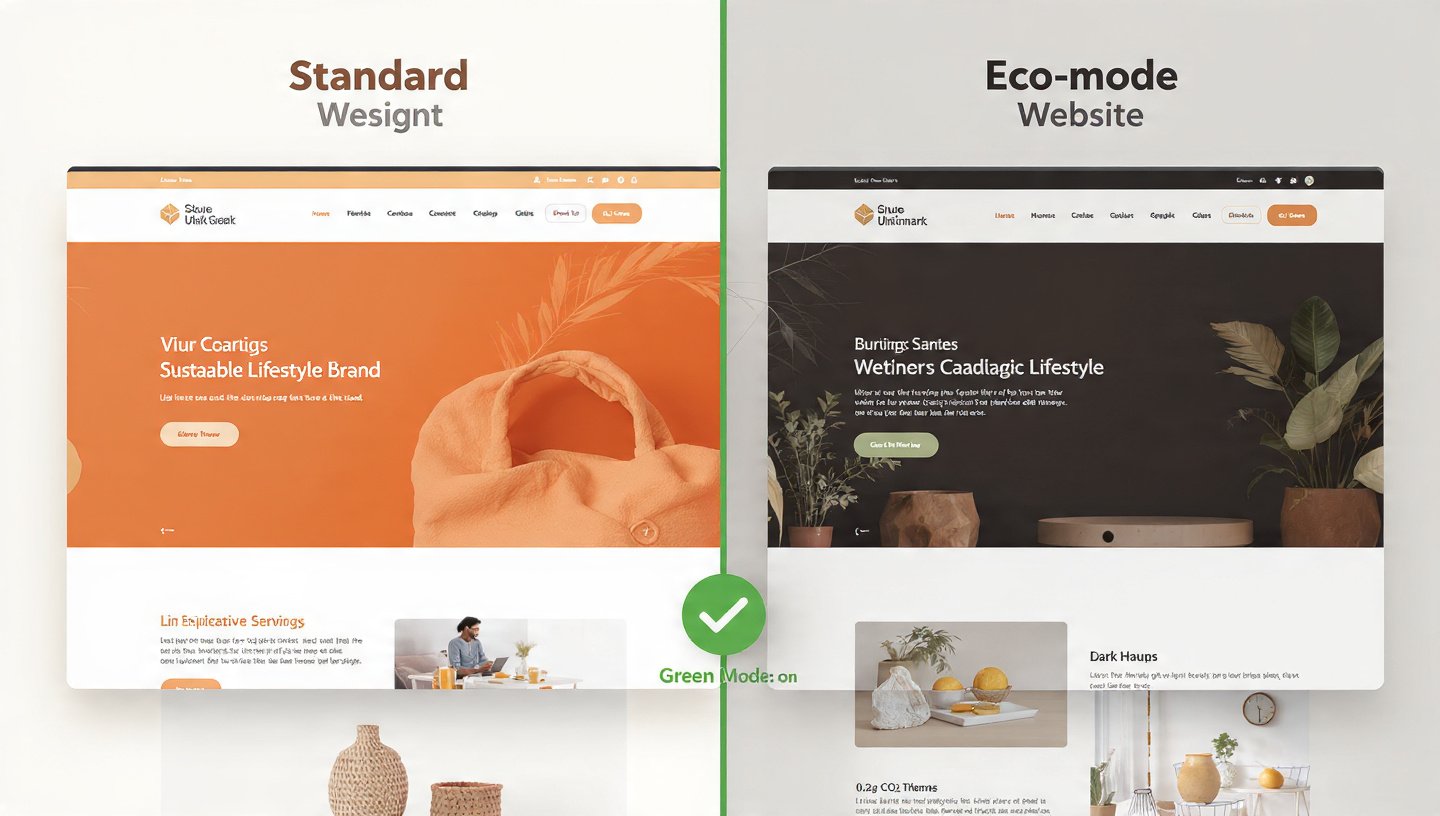
- The “Dark-First” Strategy: Since OLED screens (standard on most 2026 smartphones) use less power to display dark colors, we design default Dark Mode interfaces that save battery for the user and the planet.
3. Why Gen Z Demands “Eco-Mode”
Gen Z (and the emerging Gen Alpha) in India are “Ethical Researchers.” They actively check a brand’s ESG (Environmental, Social, and Governance) credentials before buying.
- Radical Transparency: Our 2026 custom designs include a “Carbon Label”—a small, non-intrusive badge that tells the user exactly how much CO2 was generated by their page view (typically aiming for less than 0.5g per view).
- Guilt-Free Browsing: When a brand in Park Street offers a “Low Data Mode” for shoppers on the go, it signals respect for both the user’s data plan and the environment.
4. Comparison: Traditional Web Design vs. Sustainable Web Design
| Feature | Traditional Design (2024) | Sustainable Design (2026) |
| Media | Auto-play 4K Video | User-Initiated / Optimized WebP |
| Colors | Bright White (Energy intensive) | Eco-Mode / High Contrast Dark |
| Code | Heavy Third-Party Scripts | Vanilla JS / Minimalist Libraries |
| Hosting | Standard Data Centers | Certified Green Hosting |
| SEO Impact | Good (if fast) | Excellent (Google rewards speed & efficiency) |
| User Experience | Visual-Heavy | Clarity-First / Frictionless |
5. The “Silent” SEO Benefit of Going Green
The beauty of sustainable web design is that it perfectly aligns with Google’s 2026 Ranking Signals. Google doesn’t rank you just because you’re “green,” but it does rank you for the byproducts of sustainability:
- Lightning Speed: Low-carbon sites load in under 1.2 seconds, smashing Core Web Vital benchmarks.
- Reduced Bounce Rate: Minimalist, purpose-driven layouts guide users to what they need faster, reducing wasted energy and improving conversion.
- Accessibility: Clean code and high-contrast designs are naturally more accessible to users with disabilities, another key SEO factor.
6. Use Case: The “New Town” Organic Boutique
A luxury organic skincare brand in New Town wanted their website to reflect their “Earth-First” philosophy:
- The Overhaul: We replaced their high-res model photography with elegant, low-poly 3D renders and SVG botanical illustrations.
- The Tech: Switched to a Static Site Generator (SSG) which serves pre-built pages that require zero server-side processing per visit.
- The Result: The site’s carbon footprint dropped by 70%.
- The ROI: Within six months, they saw a 22% increase in sales from the 18–25 age bracket, who cited the “fast, clean, and honest” website as a reason for their loyalty.
7. FAQ: Going Green without Losing the “Wow”
- Q: “Will my site look boring if it’s low-carbon?”
- A: Not at all. In 2026, ‘Minimalism is the New Luxury.’ We use bold typography, smart white space, and subtle micro-interactions to create a premium feel that doesn’t rely on heavy assets.
- Q: “Is Green Hosting more expensive in Kolkata?”
- A: Actually, it’s becoming the standard. Many local providers in West Bengal are now offsetting their energy use, making the cost comparable to traditional hosting.
- Q: “How do I measure my site’s current carbon footprint?”
- A: We use tools like ‘Website Carbon’ and ‘Ecograder’ to give you a baseline report before we start any redesign.
Conclusion: Design for the Planet, Rank for the World
In 2026, sustainability is no longer an “extra”—it is the foundation of digital trust. By choosing a low-carbon custom design, your Kolkata business isn’t just helping the planet; you are future-proofing your brand for the most influential generation of consumers in history.
At our Alipore studio, we prove that “Light” is the new “Powerful.”
Is your website a “Carbon Heavyweight”?
Let’s do a “Digital Carbon Audit.” We’ll measure your site’s environmental impact and provide a roadmap to a leaner, faster, and more sustainable digital presence that wins hearts and rankings.