


























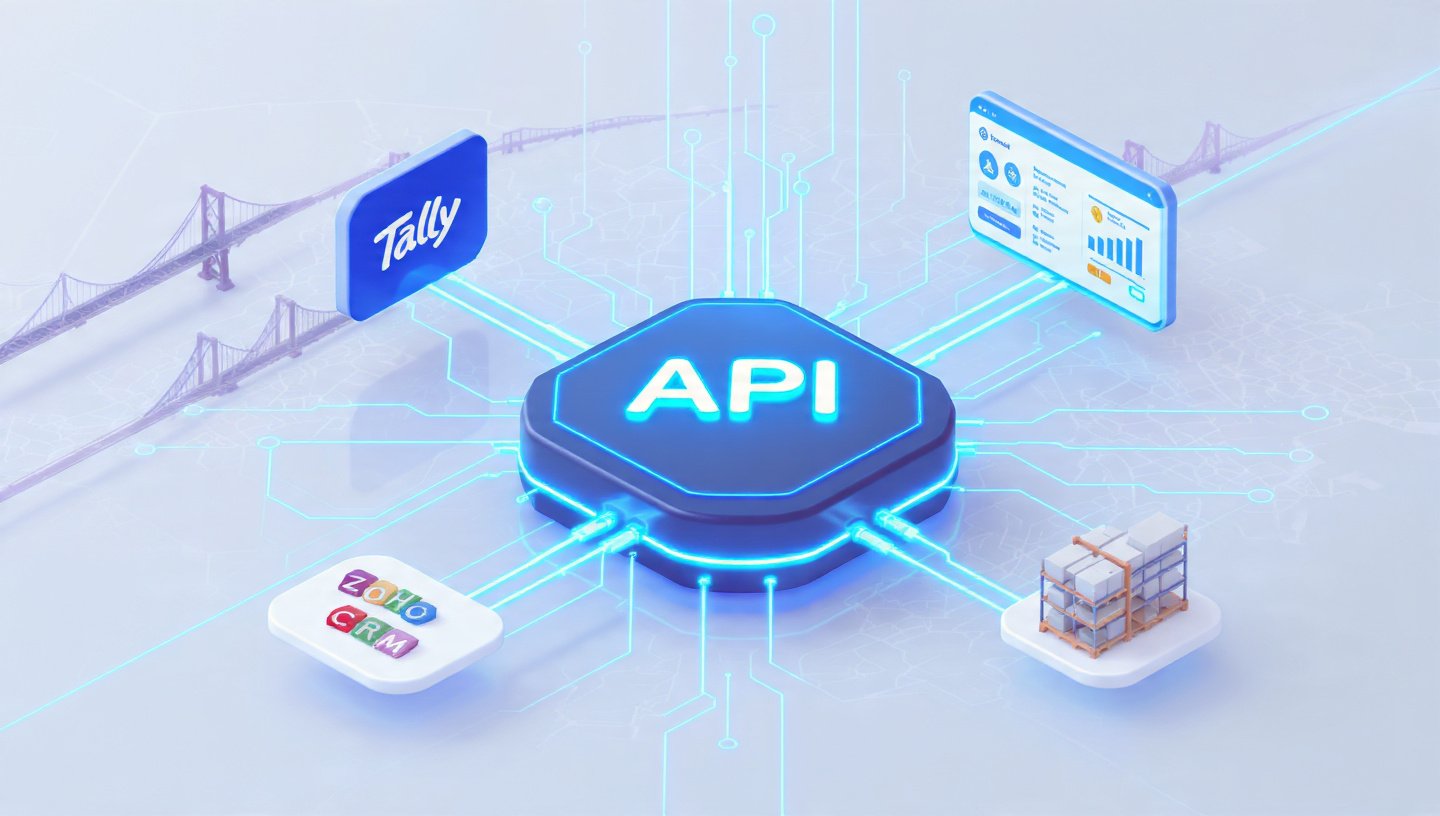
1. The “Burrabazar” Problem: Systems that Don’t Talk
Imagine this: You run a thriving wholesale business in Burrabazar with an e-commerce wing. A customer in New Town buys 100 units of a product.
- The Old Way: Your web manager sees the order, emails the warehouse, and sends a PDF to the accountant. The accountant eventually enters it into Tally.
- The 2026 Risk: By the time the warehouse updates the stock, you’ve already over-sold to a client in Mumbai. You lose money, reputation, and sleep.
API-First Design solves this by building the “bridge” before the building. Every action on your website triggers a reaction in your back-office software instantly.
2. What is “API-First” Anyway?
In traditional development, the API (Application Programming Interface) is an afterthought—something you add later to make two things connect.
In 2026, we flip the script. We design the API Contract first. This means your website is built as a set of modular “Lego blocks.”
- The Benefit: If you want to change your website’s look in two years, you don’t have to rebuild the connection to your inventory. You just swap the “Head” and keep the “Body” (the data) intact.
3. The “Big Three” Integrations for Kolkata SMEs
| Integration Type | The Goal | Popular Tools in 2026 |
| ERP (Accounting) | Every sale on your site becomes a ledger entry automatically. | Tally Prime, ERPNext, SAP Business One |
| CRM (Sales) | Leads from your “Contact Us” form go straight to your sales team’s phone. | Zoho CRM, Salesforce, HubSpot |
| Inventory/WMS | Real-time stock counts. If it’s out of stock in the warehouse, it’s “Sold Out” on the site. | Increff, Unicommerce, Logiwa |
4. Why AI Needs Your API to Work
In 2026, the rise of Agentic AI has changed the game. If you want an AI chatbot to actually help your customers (e.g., “Where is my order?” or “Apply my loyalty points”), the AI needs to “talk” to your database.
Without an API, the AI is just a glorified FAQ bot. With an API, the AI becomes a digital employee that can process returns, check delivery statuses with Delhivery, and offer personalized discounts based on a customer’s Zoho history.
5. Technical Deep-Dive: Connecting Tally Prime
For 90% of businesses in Kolkata, Tally is the holy grail. In 2026, Tally Prime’s API allows for seamless XML/JSON data exchange.
- The Flow: Customer Pays via UPI → Website calls Tally API → Tally creates a ‘Sales Voucher’ → Tally sends back a ‘Success’ signal → Website emails the GST Invoice to the customer.
- Time Saved: Approximately 15–20 minutes per order. If you process 50 orders a day, that’s 12 hours of manual labor saved every week.
6. Security: The 2026 Standard
“If my systems are connected, can a hacker get into my Tally?”
In 2026, we use OAuth 2.0 and Encrypted Webhooks. Think of the API as a security guard at the gate of your database. He only lets in people with a specific “Digital Key” and only allows them to perform specific tasks (like “Add Order,” but never “Delete Ledger”).
7. FAQ: Integration Doubts
- Q: Is my Tally compatible?
- A: Tally Prime (2026 versions) is highly integration-friendly. Even older versions can be connected using a “Middleman” server or TDL (Tally Definition Language) scripts.
- Q: Will it slow down my website?
- A: No. We use “Asynchronous Calls.” This means your website finishes the sale first, and then talks to your ERP in the background. The user never waits.
- Q: How much does this cost?
- A: A custom API integration for an SME in Kolkata typically ranges from ₹40,000 to ₹1.5 Lakhs, depending on the complexity. However, the ROI in saved man-hours usually covers the cost in 6 months.
Conclusion: The Future is Interconnected
In the 2026 economy, “Manual Data Entry” is a tax on your growth. Whether you are a manufacturing unit in Howrah or a tech firm in Salt Lake, your website should be your most efficient employee—one that never sleeps, never makes a typo, and always talks to the rest of the team.
At our Alipore studio, we specialize in “The Handshake”—the seamless connection between your beautiful frontend and your powerhouse backend.
Ready to stop the manual grind?
Let’s do an “Integration Audit.” Show us your current tools (Tally, Zoho, Excel, etc.), and we’ll map out a blueprint to make them all talk to each other by the time Pujo rolls around.