






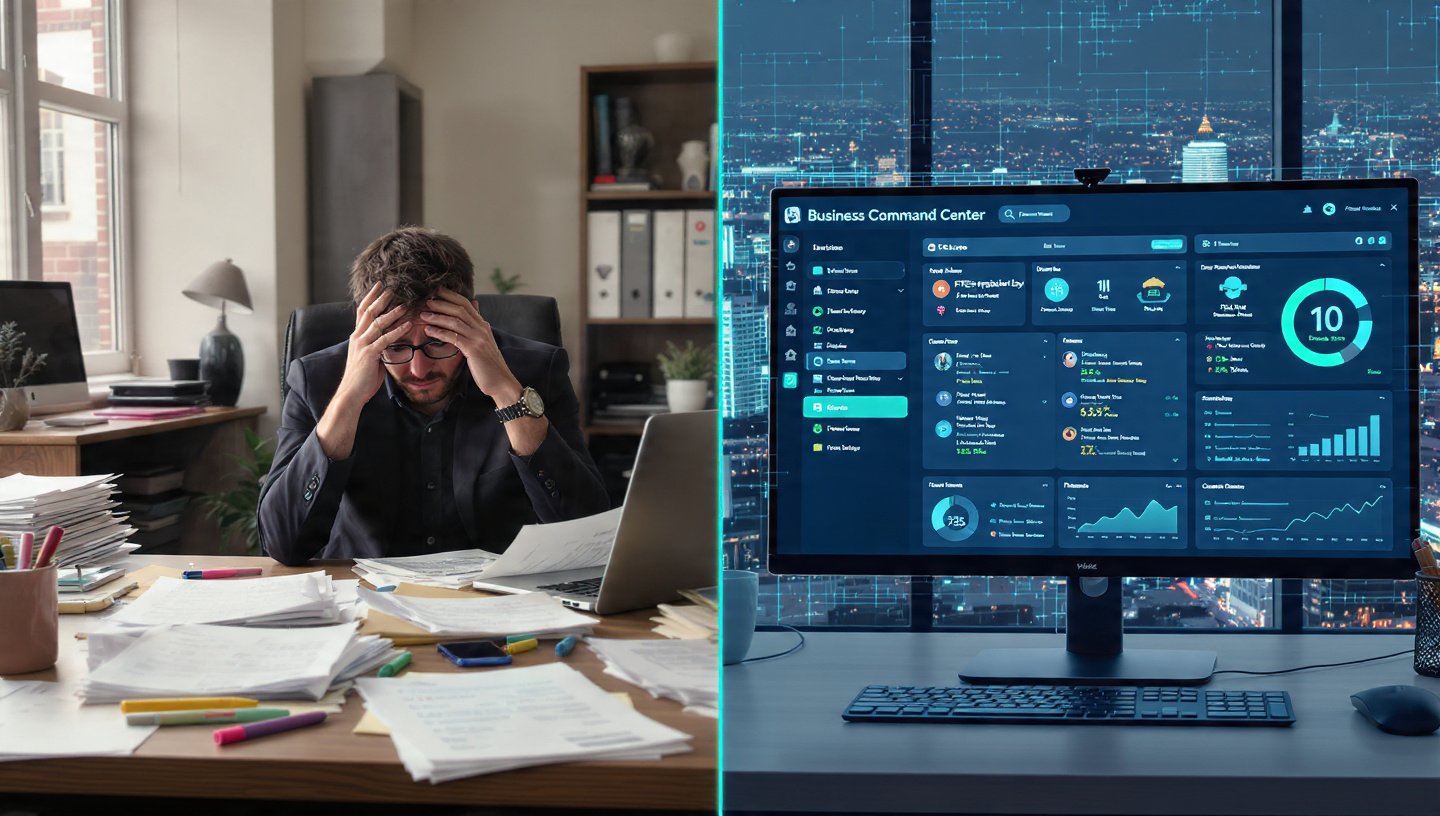
1. The 2026 Pivot: From “Online Presence” to “Operational Engine”
For years, business owners in Kolkata bought websites to “look good.” In 2026, looking good is a baseline; performing is the differentiator. High-growth firms from Sector V to Burrabazar are no longer asking for a website—they are asking for a Proprietary Web Application. Why? Because the cost of human error and manual data entry has become the single biggest “silent tax” on business growth. If you have five employees in Salt Lake manually moving data from an inquiry form to an Excel sheet, and then to an invoice, you aren’t running a modern business—you’re running a 1990s office with 2026 electricity bills.
2. The “SaaS-ification” of Your Business
When we design a custom website today, we are effectively building a Private SaaS (Software as a Service) tailored to your specific DNA.
- The “Human Middleware” Problem: Most businesses have “human middleware”—people whose only job is to bridge the gap between two disconnected pieces of software.
- The Custom Solution: We build “API-First” websites that talk to your warehouse, your accounting software (like Tally or Zoho), and your delivery partners.
- Real-World Impact: A logistics firm in Howrah replaced a 4-person tracking team with a single custom web portal. Customers now track their own parcels, and the system auto-generates e-way bills.
3. The ROI of “Replacing” vs. “Renting”
When you buy off-the-shelf software (SaaS), you are renting someone else’s vision. You pay “per user, per month.” As you grow, your bill grows.
- Ownership vs. Renting: Custom development is a CapEx (Capital Expenditure). You pay to build it once, and you own the asset forever.
- The Math of Efficiency: Let’s look at the Productivity Recovery Formula:
$$Recovery = (\text{Manual Minutes per Task} \times \text{Volume per Month}) \times \text{Employee Minute Rate}$$
If a custom app saves a team of 10 just 30 minutes a day each in a mid-sized firm in Central Kolkata, that’s 2,500+ hours of productivity recovered per year. At a modest rate, that’s a ₹15-20 Lakh injection back into your bottom line every single year.
4. Security: The “Proprietary Moat”
In 2026, templates and common plugins are the favorite targets for hackers.
- Zero-Trust Architecture: Our custom builds use “Identity-Aware” access. Whether your manager is accessing the dashboard from Alipore or while traveling to London, the system verifies their device, biometric, and behavior pattern before granting access.
- Non-Public Codebase: Unlike WordPress or Wix, where the code structure is public knowledge, a custom web app is a “Black Box” to attackers. You aren’t just buying a site; you are buying a digital fortress for your company’s data.
5. Comparison: Custom Web App vs. Ready-Made SaaS
| Feature | Ready-Made SaaS (Subscription) | Custom Web App (Proprietary) |
| Upfront Cost | Low / Monthly | Moderate to High |
| Long-Term Cost | Infinite (Scales with users) | Zero Licensing (One-time Build) |
| Workflow | You adapt to the software | Software adapts to YOU |
| Integrations | Limited to “Marketplace” apps | Unlimited (Any API, Any Tool) |
| Data Ownership | Hosted on their servers | 100% Hosted on YOUR Cloud |
| Competitive Edge | Same as your competitor | Unique to your process |
6. Use Case: The “Kolkata Manufacturing” Transformation
A furniture manufacturer near Taratala was struggling with “Return Inefficiency.”
- The Old Way: Customer calls -> Staff checks Excel -> Staff calls Warehouse -> Manual Approval -> Manual Refund. (Time: 48 hours).
- The Custom 2026 Way: We built a Customer Return Portal. The customer uploads a photo of the defect; the AI (integrated into the site) validates the damage against the original shipment data and auto-triggers a pickup and refund. (Time: 3 minutes).
- The Result: The firm handled 3x the volume during the Pujo rush without hiring a single extra customer support person.
7. FAQ: Buying a Custom Asset
- Q: Will my team need special training to use a custom app?
- A: No. Because we build it around your existing workflow, the UI is actually simpler than generic software. It only contains the buttons you actually use.
- Q: What happens if the technology changes in 2027?
- A: We build on Modular Stacks (like Next.js and Node). This means we can swap out individual parts of the app without rebuilding the whole thing, making it “Future-Proof.”
- Q: Can this replace my current CRM or ERP?
- A: It can either replace it entirely to save subscription costs, or it can act as a “Smart Layer” that sits on top of your old systems to make them easier to use.
Conclusion: The Future Belongs to the Efficient
In the 2026 economy, the businesses that thrive are the ones that “automate the mundane to liberate the human.” A custom website is no longer just a page on the internet; it is a Business Automation Hub. If you are still using manual processes for things that a few lines of code could handle, you are being outcompeted by firms that treat their website as their most productive employee.
At our Alipore studio, we don’t just “design websites.” We build Digital Equity. We transform your “bottlenecks” into “blueprints” for growth.
Ready to fire your manual processes?
Let’s do a “Workflow Friction Audit.” We’ll map out your most time-consuming task and show you exactly how a 2026 custom web app can automate it, secure it, and scale it—paying for itself within the first three months.