


















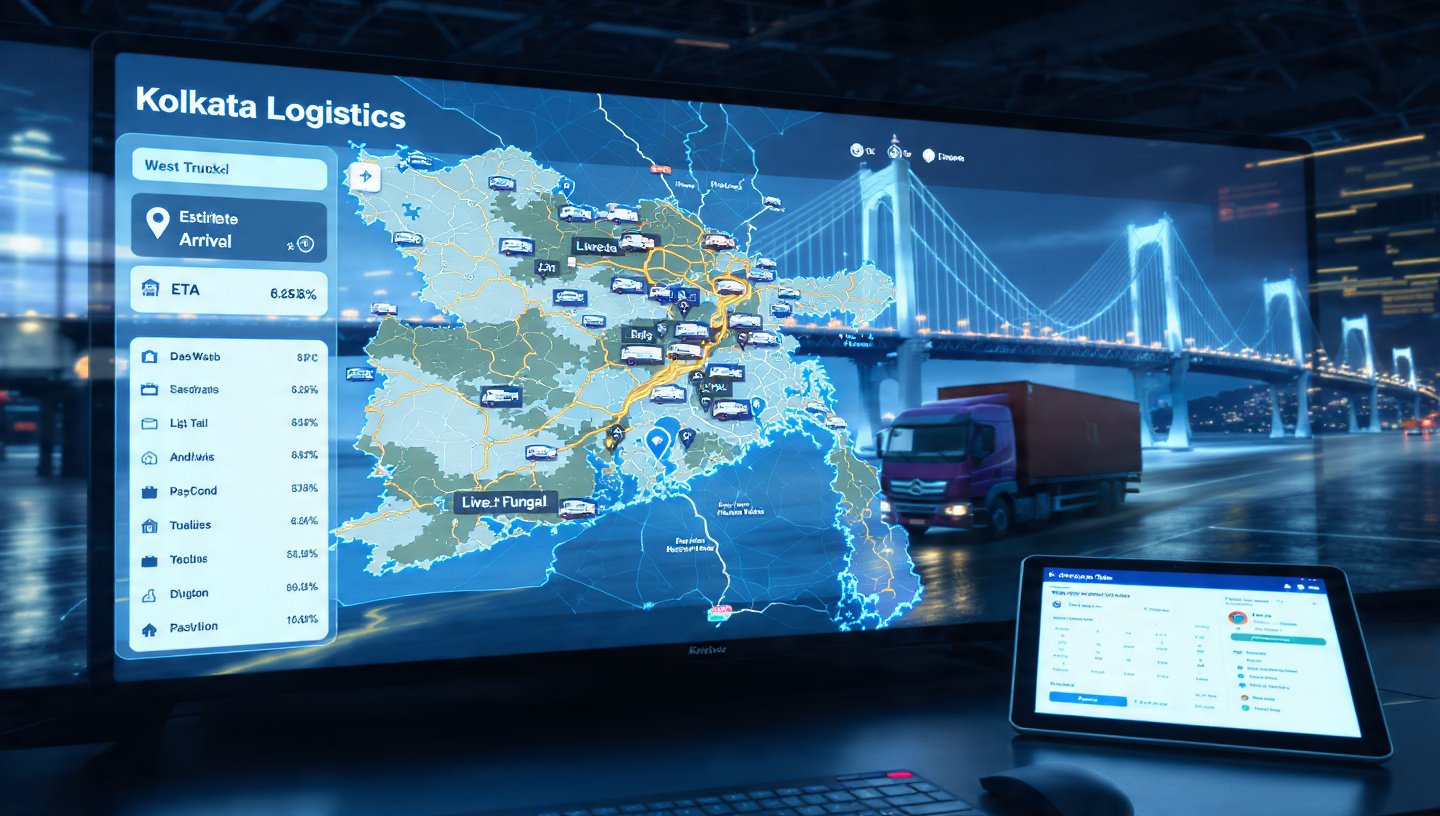
1. The Business Need: The “Where is my parcel?” Problem
In the fast-paced markets of Posta and Chandni Chowk, a 2-hour delay can cost a business lakhs. If your customers have to call your office every time they need an update, your operations are inefficient.
A Custom Logistics Website turns your business from a “trucking company” into a “tech-enabled supply chain partner.” It provides 24/7 self-service for your clients, letting them track, book, and pay without a single phone call.
2. The Classification: Why This is “Custom Website Designing”
Logistics requires logic that a basic website cannot handle. It falls under Custom because of:
- Complex API Integrations: Connecting your website to GPS hardware on your trucks (fleet tracking).
- Dynamic Rate Engines: A “Rate Calculator” that factors in weight, dimensions, fuel surcharges, and “Hill Station” extra costs for North Bengal deliveries.
- Role-Based Access: Different dashboards for the Driver (to upload proof of delivery), the Customer (to see their orders), and the Admin (to manage the fleet).
3. The “Heavy-Duty” Tech Stack
To handle thousands of tracking pings and complex calculations, we use:
- Backend: Node.js or Laravel—built for speed and handling “Real-Time” data streams.
- Database: PostgreSQL or MongoDB—to store years of shipping history and Pincode-level pricing data.
- Maps Integration: Google Maps Platform or Mapbox API for visual route tracking and distance-based price estimation.
4. 4 “Smart” Features for 2026 Logistics
- Live Shipment Tracking: A simple box on the homepage where the user enters a “Consignment Number” to see the exact location (e.g., “Sorted at Dankuni Hub” or “Out for Delivery in Salt Lake”).
- Instant Rate Calculator: Let businesses enter Pickup and Drop Pincodes + Weight to get an instant quote. This is the #1 way to capture new B2B leads.
- Digital Proof of Delivery (e-POD): Drivers can upload a photo of the signed receipt or a picture of the delivered package directly via the website’s mobile portal.
- B2B Client Dashboard: A private login for regular corporate clients to view their monthly billing, download GST invoices, and see “Volume Discount” tiers.
5. Comparison: Local Transporter vs. Tech-Enabled Logistics
| Feature | Traditional Transporter | Tech-Enabled Logistics (2026) |
| Tracking | Manual (Phone calls) | Automated (Real-time GPS) |
| Quoting | Negotiated over phone | Instant Online Rate Calculator |
| Invoicing | Paper-based / Monthly | Automated GST-ready PDF Invoices |
| Credibility | Local / Word-of-mouth | Professional Digital Authority |
6. Security and Scalability
In 2026, data security is paramount. Custom builds include:
- SSL & Data Encryption: To protect sensitive client shipment data and payment details.
- Cloud Scaling: So the website stays fast even during the Durga Puja peak season when shipping volumes triple in West Bengal.
Conclusion: Drive Your Business into the Digital Lane
Kolkata’s logistics landscape is evolving. As the city connects more deeply with the ASEAN markets via the Trilateral Highway, the demand for tech-ready transporters will skyrocket. A Custom Website isn’t just a cost—it’s the engine that will allow your fleet to grow across borders.
Ready to digitize your fleet operations?
Let’s do a “Logistics Workflow Mapping.” I’ll show you how to automate your tracking and rate systems to save hours of manual work and win bigger corporate contracts.