




1. The “Recommendation Gap” of 2026
A shocking 2026 study by SOCi found that while a brand might appear in Google’s traditional “Local 3-Pack” 35% of the time, it is recommended by AI assistants (like ChatGPT or Gemini) only 1% to 11% of the time.
- The Problem: AI is risk-averse. It won’t recommend a store if it finds conflicting data (e.g., your Facebook says you close at 8 PM but your Google profile says 9 PM).
- The 2026 Reality: Inconsistency is an automatic disqualifier. The AI would rather say “I don’t know” than give a user a wrong address in the winding lanes of North Kolkata.
2. The “Openness” Signal: Real-Time Operating Hours
In 2026, “Business Hours” are no longer static.
- Dynamic Availability: AI engines now prioritize businesses that show “Live Activity.” If your Google Business Profile (GBP) shows you are “Open” but your store’s electricity-usage data or popular-times sensor shows no one is there, the AI might suggest a competitor.
- Actionable Tip: Update your GBP “Special Hours” for every local holiday in West Bengal—from Saraswati Pujo to Poila Baisakh. This “Recency of Update” is a massive trust signal for 2026 AI.
3. Review Sentiment: From “Keywords” to “Emotions”
Google’s 2026 algorithm doesn’t just look for the word “Cheap” or “Best.” It uses Natural Language Understanding (NLU) to categorize reviews into sentiment buckets.
- The “Ambience” Score: If you run a restaurant in Ballygunge, the AI scans reviews for emotional descriptors like “Cozy,” “Hectic,” or “Great for first dates.”
- The Response Strategy: Don’t just ask for “5 stars.” Ask customers to mention a specific feeling or item. Instead of “Great food,” prompt them for “The best Kosha Mangsho I’ve had in South Kolkata.” This helps the AI map your business to specific “Intent Queries.”
4. Comparison: Local SEO (2024) vs. Hyper-Local GEO (2026)
| Factor | Traditional Local SEO (2024) | Hyper-Local GEO (2026) |
| Main Driver | Proximity (How close is the user?). | Confidence (How reliable is the data?). |
| Keywords | “Saree shop near me.” | “Authentic handloom saree shop open now.” |
| NAP Data | Names, Addresses, Phone Numbers. | Entity Alignment (Cross-platform consistency). |
| Reviews | Quantity & Rating. | Detailed Sentiment & Response Speed. |
| Visuals | Static interior photos. | Live Video & Google Lens-ready labels. |
5. Inventory-Driven Search: “If it’s not in stock, you’re not in search”
By 2026, “Local Inventory Ads” and “See What’s In Store” features are mandatory for Kolkata retailers.
- The Tech: If a user in Salt Lake searches for a specific “Logitech MX Master 4 Mouse,” the AI will only show shops that have Real-time API Sync showing that specific item is on the shelf right now.
- The Shift: Small businesses in Chandni Chowk are now using “Lite” inventory-syncing tools to ensure they don’t lose foot traffic to big-box retailers simply because their stock wasn’t “visible” to the AI.
6. Visual Discovery: Optimizing for the “AI Eye”
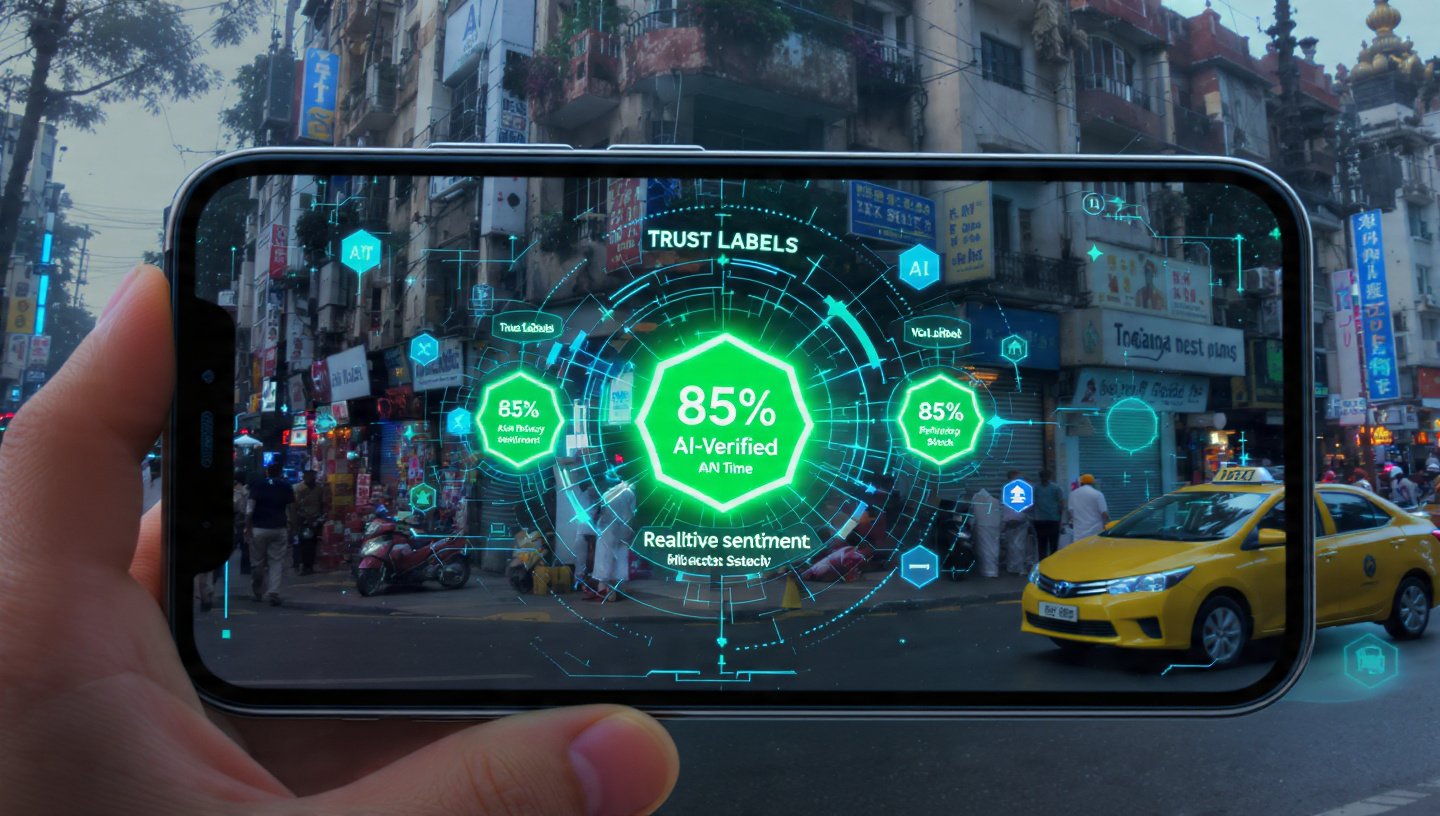
People in 2026 use Google Lens and AR glasses to find shops while walking.
- Storefront SEO: The AI “sees” your signage. Ensure your shop name and key services are in a high-contrast, machine-readable font.
- Interior Scanning: AI now uses your uploaded 360-degree photos to “virtually walk” a customer through your store. If you own a furniture showroom in Tangra, a high-quality “Virtual Tour” allows the AI to confirm you have the “Mid-century modern” style a user is asking for.
7. FAQ: Surviving the AI-Map Era
- Q: Will a 4.2-star rating hurt my AI visibility?
- A: Not necessarily. AI in 2026 prefers “Consistent 4.2” with detailed reviews over a “Fake 5.0” with no text. It looks for Authenticity.
- Q: Does my website still matter for Local SEO?
- A: More than ever. The AI uses your website to “verify” what it sees on your Map profile. Use Local Business Schema to tell the AI exactly which neighborhood (e.g., “Ward 85, Kolkata”) you serve.
- Q: Is it worth responding to every review?
- A: Yes. In 2026, your “Response Rate” is a proxy for “Operational Reliability.” A business that doesn’t respond to questions is seen as “Inactive” by the AI.
Conclusion: Be the Confident Choice
In 2026, the battle for the Kolkata consumer is won in the “Discovery Layer.” You don’t need to be the biggest store; you just need to be the one the AI can confidently recommend. By aligning your Google profile, your real-time inventory, and your customer sentiment, you become an “Authority Entity” that the AI-Map can’t ignore.
At our Alipore studio, we offer the “Local Dominator” program. We don’t just “fix your SEO”; we bridge the gap between your physical store and the AI-engines, ensuring your shop is the first name Gemini mentions when a local customer asks for help.
Is your store a “Gray Box” on the AI-Map?
Let’s do a “Local Entity Scan.” We’ll test your business across 20 different “Hyper-Local” prompts on Gemini and Apple Intelligence to see where your data is “breaking” and how many customers you’re losing to more “visible” neighbors.