





1. Beyond the Rectangle: The Rise of Web 4.0
For decades, we’ve viewed the internet through rectangular windows—phones, tablets, and monitors. But in February 2026, those boundaries are dissolving. With the mass adoption of lightweight AR glasses and spatial headsets like the Apple Vision Pro 2026 and Meta Quest 3s, the web has stepped out of the screen and into the room.
In Kolkata, a city defined by its iconic physical spaces—from the heritage corridors of North Kolkata to the glass towers of New Town—the “Digital Twin” has become the new standard for luxury and mid-market retail. We aren’t just designing pages anymore; we are designing Spatial Destinations.
2. What is a “Digital Twin” Storefront?
A Digital Twin is a dimensionally accurate, photorealistic 3D replica of your physical business. Using LiDAR scanning and physics-based rendering (PBR), we recreate your store at our Alipore studio so that:
- Remote Walkthroughs: A customer in London can “walk” through your showroom in Park Street, feeling the scale and ambiance of the space.
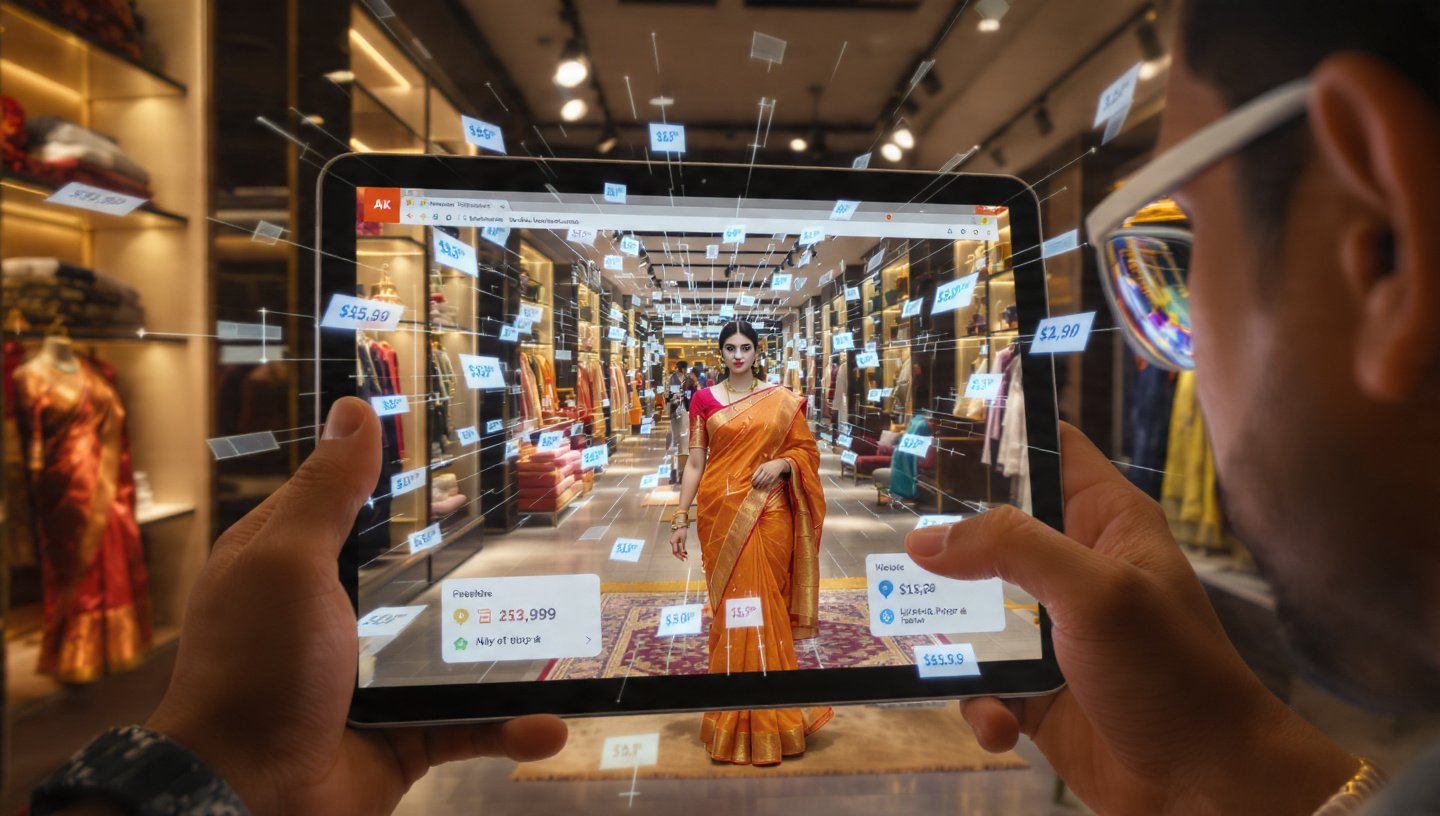
- Spatial Interactions: Instead of clicking a “Buy” button, a user reaches out (via hand-tracking) to pick up a 3D model of a product, rotate it, and see how the light hits the fabric or metal.
- Try-on in Space: Using WebXR, customers can “pull” a piece of furniture out of your website and place it in their own living room in Ballygunge to see if it fits.
3. Designing for the “Infinite Canvas”
Spatial design requires a total rethink of UI/UX. In the Spatial Web (Web 4.0), we follow new laws of physics:
- Z-Axis Hierarchy: Depth is the new “bold.” Important notifications now float closer to the user, while background information recedes into the distance.
- Gaze-Based Navigation: Users don’t always need a mouse. Our custom 3D builds use Eye-Tracking Triggers—if a customer looks at a specific jewelry piece for more than two seconds, the site gently “unfolds” the technical specs and pricing.
- Physics-Based Movement: Objects have “weight.” A heavy silk saree falls differently than a chiffon one in our 3D viewers, giving the user a “tactile” sense of quality that a 2D photo never could.
4. Comparison: 2D E-commerce vs. Spatial Web 4.0
| Feature | Legacy 2D Site (2024) | Spatial 3D Site (2026) |
| Product View | Gallery of Photos | Rotatable 3D Digital Twin |
| Navigation | Menus and Buttons | Walking / Gaze / Hand Gestures |
| Scale | Zoom in on images | Life-sized 1:1 Representation |
| Context | White background | Inside your actual Kolkata Store |
| Technology | HTML/JavaScript | WebXR / Three.js / WebAssembly |
5. The “Kolkata Advantage”: Tourism and Heritage
The Spatial Web isn’t just for retail; it’s a goldmine for Kolkata’s heritage sectors:
- Virtual Art Galleries: Local artists in Kumartuli are now hosting “Spatial Open Houses” where global collectors can walk through their workshops.
- Heritage Real Estate: Developers in Alipore are using 3D twins of “to-be-built” apartments, allowing buyers to experience the view from the 20th floor before the foundation is even poured.
- Immersive Dining: Restaurants in Sector V are letting users “pre-visit” their tables, checking the lighting and view before making a high-end booking.
6. Use Case: The “South City Mall” Luxury Boutique
A high-end jewelry brand in South City Mall faced a challenge: their international clients couldn’t visit the store to see the craftsmanship.
- The Build: We created a high-fidelity Spatial Twin of their boutique.
- The Tech: We used USDZ and GLTF formats (the “JPEGs of 2026”) to ensure the 3D assets loaded instantly on iPhones and Vision Pros.
- The Result: A 55% increase in cross-border sales. Customers reported that “being in the store” virtually gave them the confidence to make 6-figure purchases without a physical visit.
7. FAQ: Transitioning to 3D
- Q: “Will this work on a regular smartphone?”
- A: Yes! While headsets offer the most ‘immersion,’ our 3D sites are ‘Responsive.’ On a phone, they work as a ‘Window’ you can move around (gyroscope-control), making it accessible to everyone in Kolkata.
- Q: “Is LiDAR scanning expensive?”
- A: In 2026, scanning technology has been democratized. We can scan a standard 1,000 sq. ft. store in a few hours, making it affordable even for boutique shops in Gariahat.
- Q: “Does it slow down my site?”
- A: We use ‘Streaming Geometry.’ The site loads the ‘low-poly’ version first so the user can start moving instantly, while high-definition textures ‘stream’ in as they get closer to an object.
Conclusion: The End of Browsing, The Start of Being
In 2026, your website is no longer a place people go to; it is a place people are in. Spatial computing has turned the cold, flat internet into a warm, inviting extension of your physical brand. For businesses in Kolkata, this is the ultimate opportunity to take the “Soul of the City”—its architecture, its hospitality, its vibe—and project it to the entire world.
At our Alipore studio, we are building the portals to the next dimension.
Is your brand still living in a 2D world?
Let’s do a “Spatial Brand Visioning Session.” We’ll show you how a Digital Twin of your space can revolutionize your customer journey and put your business at the forefront of Kolkata’s Web 4.0 movement.