




1. From “Interrogation” to “Conversation”
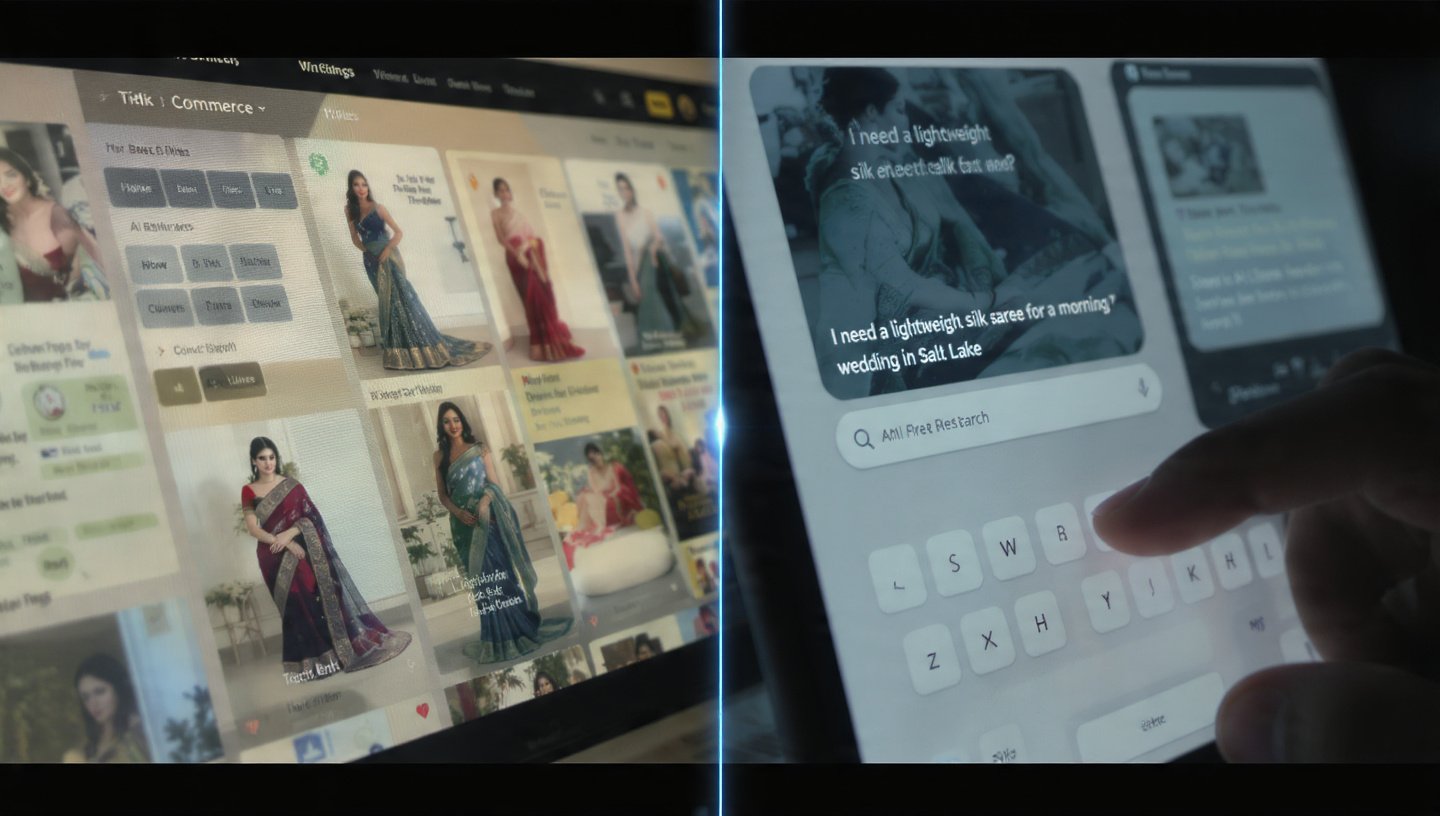
Traditional web design is an interrogation: Click this category. Select this price range. Choose this color.
- The 2026 Shift: Conversational UX flips the script. It uses Intent-Based Discovery.
- Local Example: Instead of a customer in Ballygunge searching for “Formal Shoes,” they tell your site, “I have a corporate meeting at Sector V tomorrow and need something comfortable but professional.” The AI understands the context (weather, location, occasion) and presents 3 perfect options instantly.
2. The 3 New “Laws” of 2026 UX
A. The Law of Predictive Intent
In 2026, the interface shouldn’t wait for a command; it should anticipate the next move.
- How it works: If a user has spent 30 seconds looking at a “How-To” guide on your site, the UI subtly shifts to offer a “Quick Consultation” button or a related product link. The site “listens” to the user’s behavior.
B. The Law of “Zero UI”
The best interface in 2026 is often no interface at all.
- Voice & Gestures: With 5G now standard in Kolkata, users are increasingly using voice commands while commuting on the Metro or cooking. Your site must be Multimodal—allowing a user to start a search via voice and finish it via touch without losing their place.
C. The Law of Adaptive Layouts
By 2026, we’ve moved past simple responsive design.
- Liquid Glass Aesthetic: Interfaces now use translucent materials and depth to guide the eye. If a user is in “Browsing Mode,” the layout is airy and visual. If they move to “Checkout Mode,” the layout “tightens” up, removing distractions and focusing purely on the transaction.
[Table: Traditional UX (2020) vs. Conversational UX (2026)]
| Feature | Traditional UX | 2026 Conversational UX |
| Navigation | Mega-menus & Sidebars. | Natural Language Search / AI Assistant. |
| Personalization | Based on past purchases. | Based on real-time intent & context. |
| Input | Typing & Clicking. | Voice, Gestures, & Adaptive UI. |
| Design Style | Flat & Static. | “Liquid Glass” & Dynamic. |
3. The Psychology of “Trust by Design”
In a city like Kolkata, where word-of-mouth is king, your website needs to sound like a trusted friend.
- Micro-Copy Matters: Instead of a cold error message like “Invalid Input,” a 2026 conversational site says, “Oops! That doesn’t look like a standard phone number. Could you double-check it for us?”
- Transparency: Always clarify when an AI is speaking. Trust in 2026 is built by being an “Honest Assistant,” not a “Fake Human.”
4. Designing for “Micro-Interactions”
Conversations aren’t just words; they are signals. In 2026, Micro-interactions provide the “body language” of your site.
- A button that subtly glows when you hover near it.
- A progress bar that “pulses” to show it’s working.
- A haptic vibration on the phone when a payment is successful.These small cues reduce Cognitive Load and make the user feel “heard” by the technology.
5. Accessibility: The Ultimate Conversation
In 2026, accessibility is no longer a “feature”—it’s a core principle of conversational design.
- Inclusive Input: If a user in Howrah has their hands full or has a motor impairment, a conversational UI that responds to voice is their primary way to interact with your brand. By designing for “Conversation,” you naturally become more accessible to everyone.
6. Tooling for 2026 Conversational UX
- For Design: Tools like Figma AI now allow us to prototype “branching” conversations instead of just static screens.
- For Implementation: We use Generative UI frameworks that can actually change the website’s code in real-time to match what the user is asking for.
7. FAQ: The Conversational Transition
- Q: Does this replace my regular website?
- A: No. It enhances it. You still have your pages, but your “Navigation” and “Search” become a conversational layer that sits on top.
- Q: Is it “creepy” if the site predicts what I want?
- A: Not if it’s helpful. The key in 2026 is “Personalization without Intrusion.” We only use data the customer has willingly shared or demonstrated through their current session.
- Q: Will this work for a small business in Kolkata?
- A: Yes! In fact, small businesses often have a “closer” relationship with their customers. A conversational site helps you scale that “personal touch” online.
Conclusion: Speak Their Language
The websites that win in 2026 are the ones that stop acting like machines and start acting like people. By applying the laws of Conversational UX, you aren’t just making a prettier site; you are building a deeper relationship with every person who visits from Park Street to Patuli.
At our Alipore studio, we specialize in “Human-Centric Digital.” We don’t just design layouts; we script experiences that convert because they actually understand the user.
Is your website a “Silent Catalog” or a “Helpful Partner”?
Let’s do a “Conversation Audit.” We’ll look at your top 3 user paths and show you exactly where a “Conversational Layer” could remove friction and increase your conversion rate by 15% or more.