






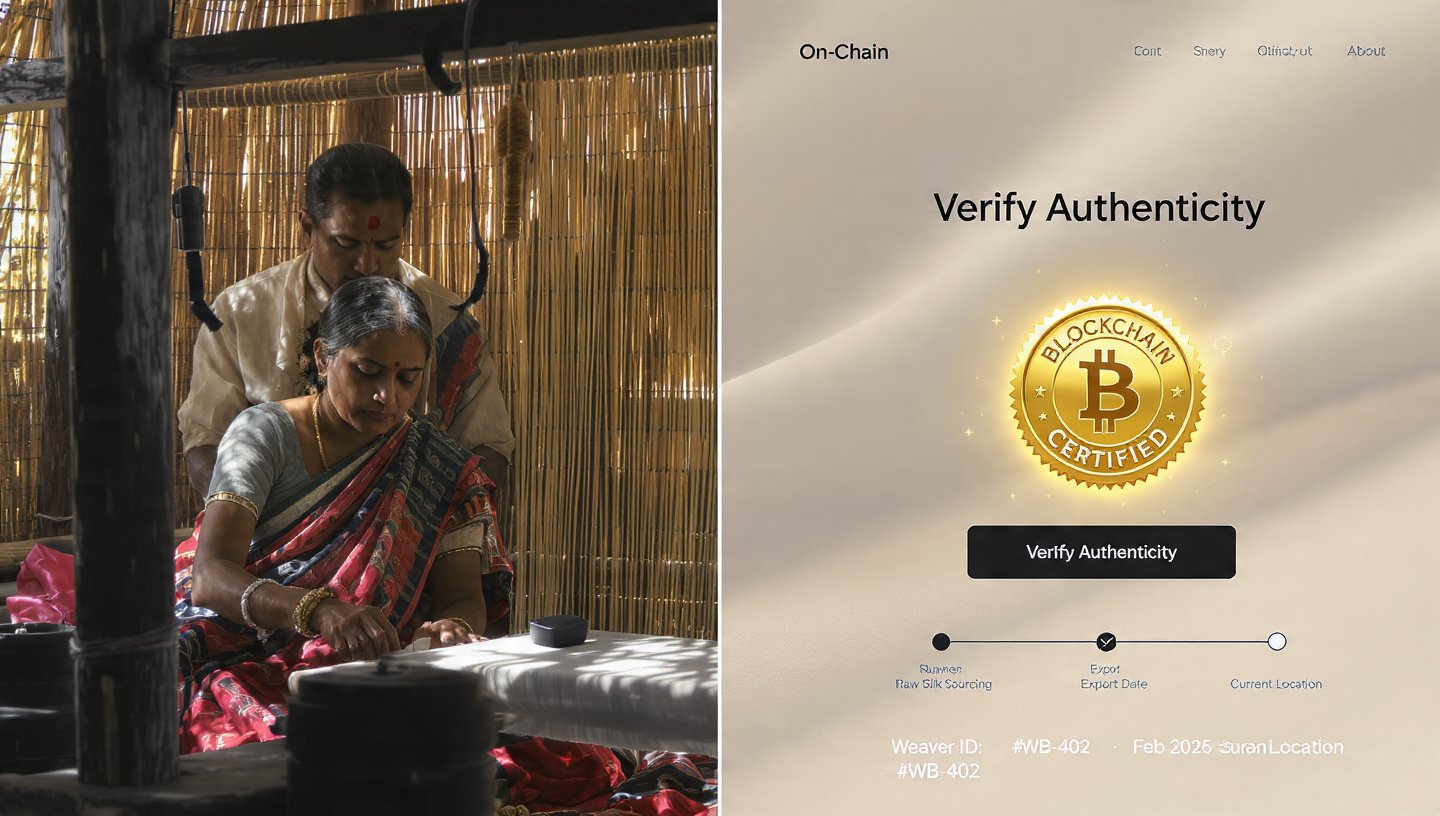
1. The “Authenticity Crisis” of 2026
As the global demand for “Slow Fashion” and artisanal goods peaks in February 2026, a major problem has emerged: Digital Counterfeiting. Cheap, machine-made replicas are flooding the web, using stolen photos of genuine Kantha work or Dhokra art from West Bengal. For a premium exporter in Kolkata, a beautiful website is no longer sufficient to close a deal; you need Proof.
At our Alipore studio, we are solving this by integrating On-Chain Provenance directly into custom web architectures. We are moving beyond the static “About Us” page and creating “Living Histories” for every product you export.
2. What is On-Chain “Proof of Origin”?
Every high-value item—be it a $5,000 silk saree or a rare leather bag from the Kolkata Leather Complex—is assigned a Digital Twin on a secure, eco-friendly blockchain (like Ethereum 2.0 or a permissioned Hyperledger).
This creates a permanent, unalterable record of:
- The Artisan’s Identity: A secure ID for the weaver or craftsman, ensuring they get the credit (and often a royalty) for their work.
- The Material Source: Verification that the silk came from Murshidabad or the leather was ethically sourced.
- The Sustainability Journey: Evidence of fair wages and low-carbon transport, essential for the EU’s new Digital Product Passport regulations.
3. Designing the “Trust Portal”
When we build a website for an exporter, the “Trust Portal” is the centerpiece:
- One-Scan Verification: A customer in Paris scans a hidden QR code on their purchase. The website instantly opens a unique page—not a generic product page, but the exact record of that specific item’s birth and journey.
- Visualized Supply Chain: We use interactive maps and timelines to show the “Chain of Custody.” Users can see when the item left the port of Haldia and arrived in their city.
- NFT Ownership Deeds: For ultra-luxury items, the purchase includes a non-fungible token (NFT) that acts as a digital deed. If the owner ever resells the item, the “On-Chain” history stays with it, maintaining its resale value.
4. Comparison: Traditional Trust vs. Blockchain Trust
| Feature | Traditional Website (2024) | On-Chain Website (2026) |
| Claim of Origin | Text and Images (Self-Claimed) | Cryptographic Proof (Third-Party Verified) |
| Counterfeit Risk | High (Easily copied) | Near Zero (Uncopyable Ledger) |
| Customer Trust | Based on Brand Reputation | Based on Mathematical Verifiability |
| Compliance | Manual Paperwork | Automated Digital Product Passports |
| Resale Value | Declines without papers | Stays High (Verifiable Lineage) |
5. The “GI Tag” Evolution in West Bengal
West Bengal holds several Geographical Indication (GI) tags. In 2026, we are taking these local honors global by digitizing them:
- Darjeeling Tea: Our web designs for tea estates now include “Batch-Level Transparency.” An AI agent or a human connoisseur can verify the exact elevation and harvest date of a tea tin by querying the blockchain through the site.
- Shantipuri Sarees: By embedding NFC tags into the weave, we allow the website to “talk” to the saree. Touching a phone to the fabric pulls up a video of the specific artisan who made it.
6. Use Case: The “Kolkata-to-Milan” Leather Export
A premium leather manufacturer in Bantala was struggling with Italian buyers questioning the “ethical sourcing” of their raw materials.
- The Solution: We redesigned their B2B portal to include On-Chain Traceability.
- The Tech: We used Zero-Knowledge Proofs (ZKPs)—allowing the manufacturer to prove they met environmental standards without revealing sensitive supplier pricing.
- The Result: A 30% increase in contract value. The Italian buyers were willing to pay a premium because the blockchain provided the “Compliance Certainty” they needed for EU customs.
7. FAQ: Implementing Blockchain for Small Exporters
- Q: “Is blockchain too expensive for a small business?”
- A: Not anymore. We use ‘Layer 2’ solutions that make ‘minting’ a product’s history cost less than a cup of tea in College Street.
- Q: “Does it slow down my website?”
- A: No. The website stays fast. We use ‘Asynchronous Fetching’ where the blockchain data only loads when the user requests the ‘Verification’ view.
- Q: “What if the artisan doesn’t have a smartphone?”
- A: We use ‘Cooperative Nodes.’ A local NGO or a cluster manager in the village uses one device to log the work of 50 artisans, keeping the costs low while maintaining the chain of trust.
Conclusion: Trust is the New Currency
In 2026, the world is skeptical. They have seen too many “fake” stories. By integrating On-Chain Authenticity into your custom website, you are telling the world that your brand has nothing to hide. You are turning the heritage of Kolkata into a modern, verifiable, and high-value asset.
At our Alipore studio, we build the bridges that connect ancient craft to future trust.
Ready to prove your brand’s value?
Let’s do a “Provenance Mapping Session.” We’ll look at your supply chain and show you how a blockchain-backed “Proof of Origin” can unlock new luxury markets for your products in Europe, the US, and beyond.