
1. Solving the “Size & Weight” Barrier
One of the biggest hurdles for Kolkata’s high-value heritage exports—like Bankura Horses, Bishnupur Terracotta panels, or Kumartuli-style bronze casts—has always been the “Fear of the Fit.” A buyer in London or San Francisco might love the artistry, but they hesitate: “Is it too big for my hallway? Will the clay texture clash with my modern decor?”
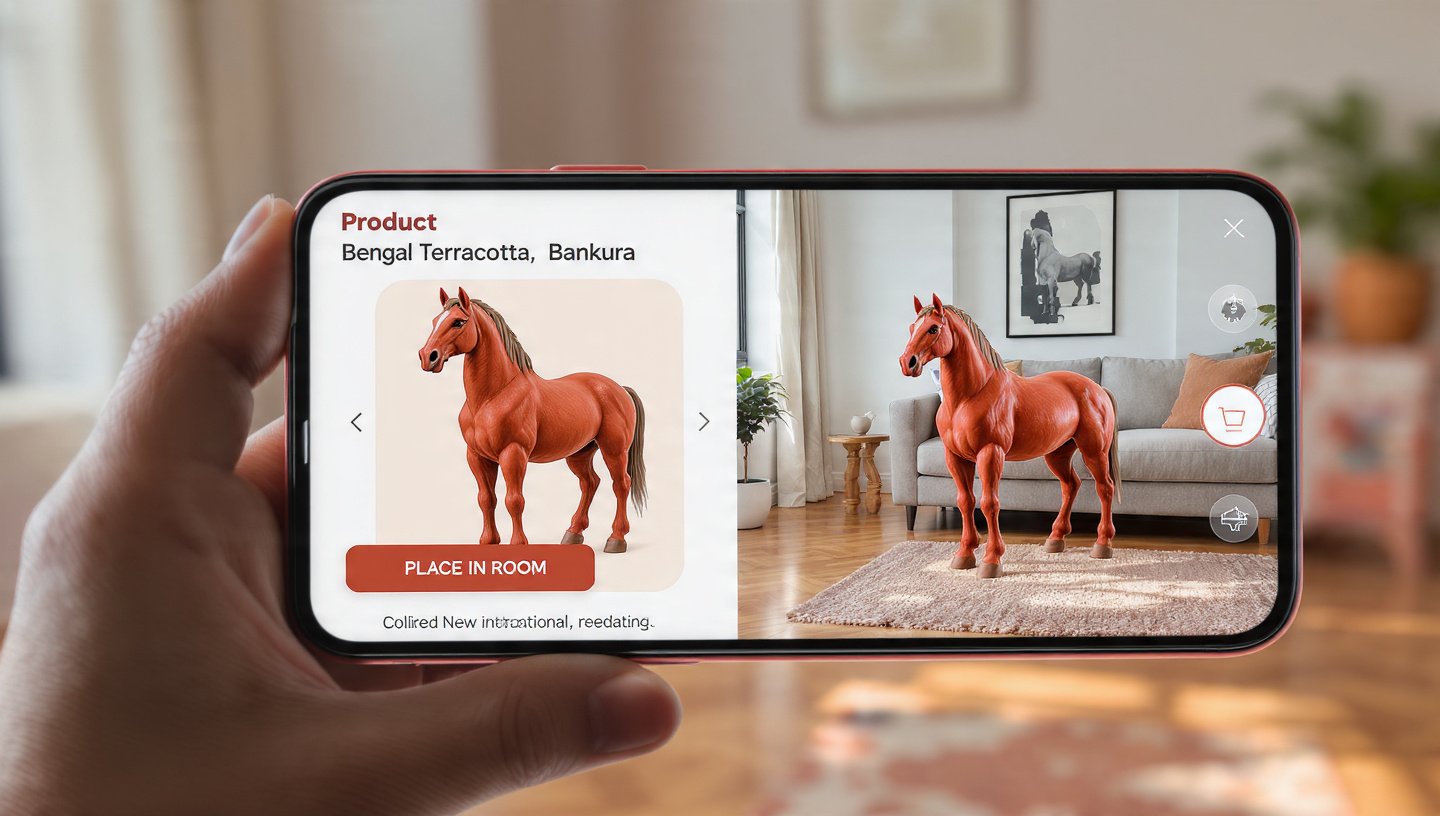
By February 2026, we have solved this with WebAR (Web-based Augmented Reality). Unlike traditional AR that required clunky app downloads, WebAR runs directly in the mobile browser. In 2026, a “Basic” e-commerce site for a heritage brand must be an Immersive Gallery.
2. The WebAR “Live Placement” UX
In 2026, we don’t just show photos; we provide a 1:1 Digital Twin. * Zero-Friction Activation: The user taps a “View in Your Space” button. The website instantly accesses their camera (no app needed), detects the floor or table, and anchors the 3D model of the artifact.
- Photorealistic Textures (PBR): Using Physically Based Rendering (PBR), we ensure the digital clay reflects light exactly like real Terracotta. If the user moves their phone, the shadows on the floor shift in real-time.
- True-to-Scale Accuracy: We hard-code the exact dimensions. If the horse is 4 feet tall, it appears exactly 4 feet tall in the buyer’s living room. This “Mental Ownership” increases purchase intent by over 40%.
3. The ROI of “Try Before You Buy”
Implementing AR isn’t just about the “Cool Factor”; it’s a cold, hard business decision for Kolkata’s exporters:
- Reducing Return Rates: Shipping a 20kg terracotta piece to Europe and having it returned is a financial nightmare. AR reduces “Wrong Size/Wrong Style” returns by over 60%.
- Global Trust Building: 77% of 2026 consumers prefer interacting with a 3D model before a high-value purchase. For a brand based in Kolkata, providing this level of tech signals that you are a world-class, reliable player.
- Higher Conversion: Data from 2025-26 shows that users who engage with AR features are 11 times more likely to add the item to their cart compared to those looking at 2D images.
4. Designing the “Heritage-Modern” UI
The challenge in 2026 is blending ancient art with cutting-edge tech without losing the “Soul.”
- Minimalist Scrollytelling: As the user scrolls, the 3D model of the sculpture rotates slightly, revealing the intricate hand-carved details (like the fine lines of a Dokra bronze).
- Contextual Lighting Toggles: We include a “Day/Night” toggle in the AR viewer, allowing the buyer to see how the artifact will look under warm evening lamps versus bright morning sunlight.
- Integrated “Click & Consult”: If a buyer is unsure after the AR preview, a floating “WhatsApp an Expert” button connects them to a specialist in Salt Lake who can explain the history of that specific piece.
5. Comparison: Standard Gallery vs. Phygital WebAR Gallery
| Feature | Standard Gallery (2024) | Phygital WebAR Gallery (2026) |
| Product View | Static 2D Images | Interactive 3D + AR Placement |
| Buyer Friction | High (Size uncertainty) | Low (True-to-scale visual proof) |
| Tech Requirement | None | Browser-native (No App Download) |
| Texture Detail | Limited by photo quality | 8K PBR Textures (Realistic Clay/Metal) |
| Return Risk | High (Domestic & Int’l) | Drastically Reduced |
6. Use Case: The “Kumartuli-to-Cannes” Success Story
A premium art house specializing in bronze sculptures from Kumartuli wanted to target the European luxury decor market:
- The Tech: We built a custom e-commerce site with integrated 8K 3D models. 2. The Experience: A designer in Cannes used the “View in Room” feature to see if a bronze Ganesha would fit their client’s marble foyer.
- The Result: The brand closed a ₹12 Lakh sale entirely online, without the buyer ever visiting India. The buyer cited the “Confidence of the AR fit” as the deciding factor.
7. FAQ: AR for Heritage E-commerce
- Q: “Is WebAR too heavy for a typical mobile site?”
- A: No. In 2026, we use USDZ and GLB file formats optimized for 5G. The AR assets load in under 2 seconds, often faster than a heavy high-res video.
- Q: “Do I need to 3D scan every item I sell?”
- A: For unique, one-of-a-kind masterpieces, yes. For standardized heritage items (like specific sizes of Bankura horses), we create one high-quality ‘Base Model’ and use it across the catalog.
- Q: “What about the cost of 3D modeling in Kolkata?”
- A: Kolkata has become a hub for 3D artists. In 2026, creating a web-ready 3D model of a sculpture costs roughly the same as a professional multi-angle photoshoot.
Conclusion: The End of “Digital Distance”
In 2026, the distance between a craftsman in Howrah and a collector in New York is zero. By building “Phygital” galleries that use WebAR, we are removing the last barrier to global heritage sales: the physical uncertainty of the object. Your website is no longer just a shop; it’s a portal that places a piece of Bengal’s soul into a home halfway across the world.
At our Alipore studio, we build the portals that bridge the physical and the digital.
Is your art ready for the global stage?
Let’s do a “3D & AR Readiness Session.” We’ll review your catalog and show you how to turn your static photos into interactive 3D assets that sell themselves to the world.