
1. The Counterfeit Crisis & The 2026 Solution
For decades, the artisans of Bishnupur (Baluchari Sarees) and Bankura (Dokra/Terracotta) have faced a silent enemy: mass-produced machine fakes sold under their names. By February 2026, the market has finally provided a “Truth Layer.”
In our new “Heritage Tech Loop,” we explore how “Basic” website designing has evolved to include Digital Provenance. A website is no longer just a gallery; it is a Legal Ledger. By integrating blockchain-backed certificates, Kolkata’s heritage brands are successfully separating themselves from “fast-fashion” imitators.
2. The Digital Passport: What is a “Verified” Build?
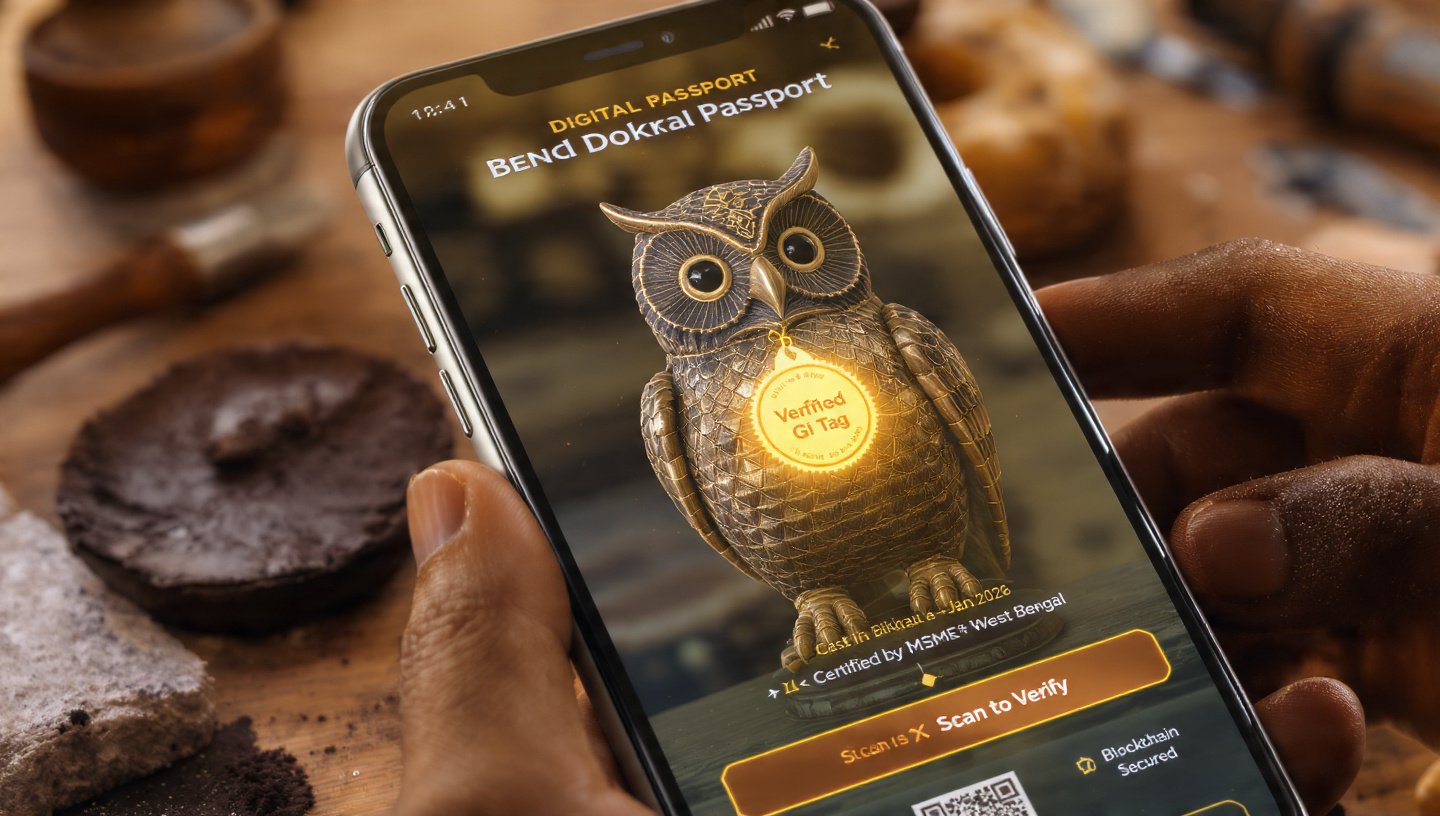
In 2026, every high-value craft item comes with a Digital Passport. When we design a “Basic” site for a heritage brand, we include:
- Unique Item Minting: Every saree or sculpture is assigned a unique hash on a hybrid blockchain (often following the West Bengal Blockchain Promotion Guidelines).
- The “Scan-to-Source” UX: We place a QR code scanner directly in the website’s header. A buyer in Tokyo or New York can scan the tag on their physical product, and the website instantly displays the Immutable Record of who made it and where.
- Non-Fungible Certificates: Instead of a paper receipt that can be lost, the buyer receives a digital “Certificate of Authenticity” (COA) in their web-wallet, proving the item’s resale value.
3. GI-Tag Integration: From Paper to Pixels
The Geographical Indication (GI) Tag is Bengal’s most powerful branding tool. In 2026, we’ve moved beyond just printing the GI logo.
- Live GI Registry Fetch: Our custom web modules link directly to the MSME & Textiles Department database. If a vendor claims to sell “Santiniketan Leather,” the website automatically checks their AU (Authorized User) Number in real-time.
- Green-Light Trust Signals: If the verification passes, the product page displays a live “Verified Origin” badge. If the data doesn’t match, the badge disappears—protecting the brand from legal liability under the GI Act 1999 enforcement updates.
4. Designing for the “Ethical Globalist”
The 2026 buyer doesn’t just buy a product; they buy the impact.
- Artisan Micro-Portfolios: We design “Basic” sites that give every artisan their own mini-page. When a customer buys a Murshidabad Silk scarf, they can click a link to see the weaver’s profile, their village, and the fair-wage certification associated with that specific batch.
- Impact Visualizers: We use 2026 data widgets that show the direct economic benefit. “Your purchase directly supported 3 weeks of sustainable livelihood for a family in the Bankura cluster.”
5. Comparison: Traditional Catalog vs. Blockchain-Verified Site
| Feature | Legacy Craft Site (2024) | 2026 Heritage Tech Site |
| Authenticity Proof | Scanned Paper Certificate | Immutable Blockchain Ledger |
| Origin Tracking | “Made in India” Label | GPS-Verified Cluster Mapping |
| Buyer Assurance | Trust based on Brand Name | Trust based on Math/Cryptography |
| Resale Value | Low (hard to prove origin) | High (Transferable Digital COA) |
| GI Compliance | Static Logo | Live API-Verified AU Status |
6. Use Case: The “Phulia” Handloom Export Hub
A weaver’s cooperative in Phulia was struggling with “Powerloom Fakes” flooding the market.
- The Intervention: We built a “Basic” export site where every saree had a hidden NFC (Near Field Communication) thread woven into the anchal.
- The Web Interface: Customers tapped their phone to the saree, and our web app instantly pulled up the “Looms of Bengal” certificate.
- The Result: The cooperative saw a 35% increase in export price as Western boutiques were willing to pay a premium for “Math-Verified” authenticity.
7. FAQ: Blockchain for Small Artisans
- Q: “Is blockchain too expensive for a small NGO or artisan group?”
- A: No. In 2026, we use ‘Layer 2’ solutions and ‘Gas-less’ minting. The cost per certificate is now less than the cost of a high-quality paper hangtag.
- Q: “Does the artisan need a crypto wallet?”
- A: Not necessarily. We use ‘Managed Wallets’ where the brand or cooperative handles the tech, while the artisan simply receives their payment via UPI as usual.
- Q: “What if the QR code is copied?”
- A: We use ‘Tamper-Evident’ QR tags and ‘Physical-to-Digital’ (Phygital) binding. If a tag is peeled off, the circuit breaks, and the digital certificate is marked as ‘Potentially Compromised’ on the website.
Conclusion: The New Gold Standard of Trust
In 2026, “Basic” website design is no longer about how your site looks—it’s about how much the world can trust it. By anchoring Kolkata’s ancient crafts to the blockchain, we aren’t just building websites; we are building an armor for our cultural identity.
At our Alipore studio, we believe that the best way to preserve the past is to secure it with the future.
Is your heritage brand protected?
Let’s do a “Provenance & GI-Readiness Audit.” We’ll show you how to integrate digital certificates into your site to stop counterfeits and unlock premium global markets.